
Quantitative Easing vs. Quantitative Tightening
How the Fed controls the money supply and markets

Welcome to JT Finance, the newsletter that broadens your knowledge of the world.
Learn something new? Subscribe to stay up to date with new posts and articles.

Today’s Points
Quantitative Easing
Quantitative Tightening
The Effects on the Market
Quantitative Easing
Quantitative easing or QE is a monetary policy tool that the Federal Reserve uses to stimulate the economy.
It is a bit of an unconventional tool, and they use it when their ability to lower interest rates dries up.
Here is how it works…
The Fed buys financial assets (government bonds and mortgage-backed securities) on the market to decrease interest rates and increase the money supply/liquidity.
This tool encourages lending and investment, which stimulates the economy.
Increasing the supply of money lowers interest rates further, which allows banks and financial institutions to lend with better terms.
Whenever the Federal Reserve increases the amount of assets it has on its balance sheet that is QE.
We can see what that looks like in this chart. The yellow shaded areas are when the Fed is actively purchasing assets to stimulate the economy (QE).
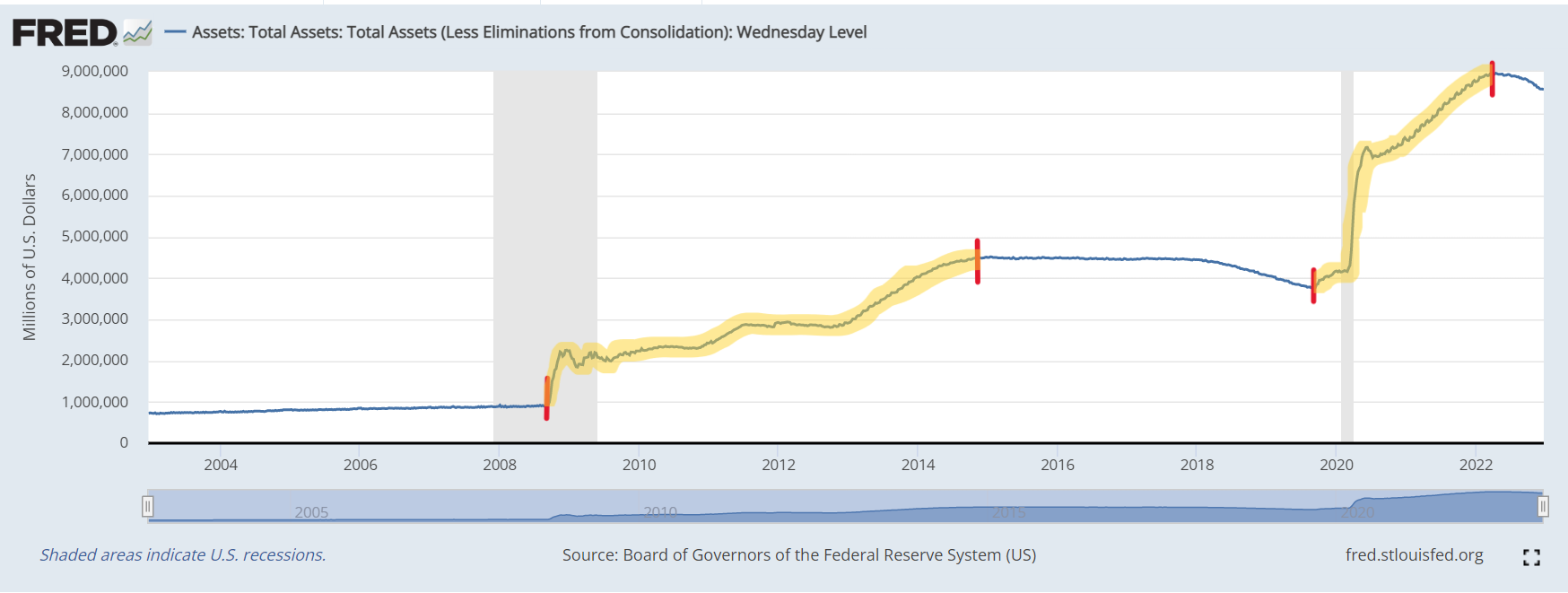
This monetary policy was first implemented in the U.S. to stimulate the economy amidst the 2008 Financial Crises, and it is credited for getting us out of that recession.
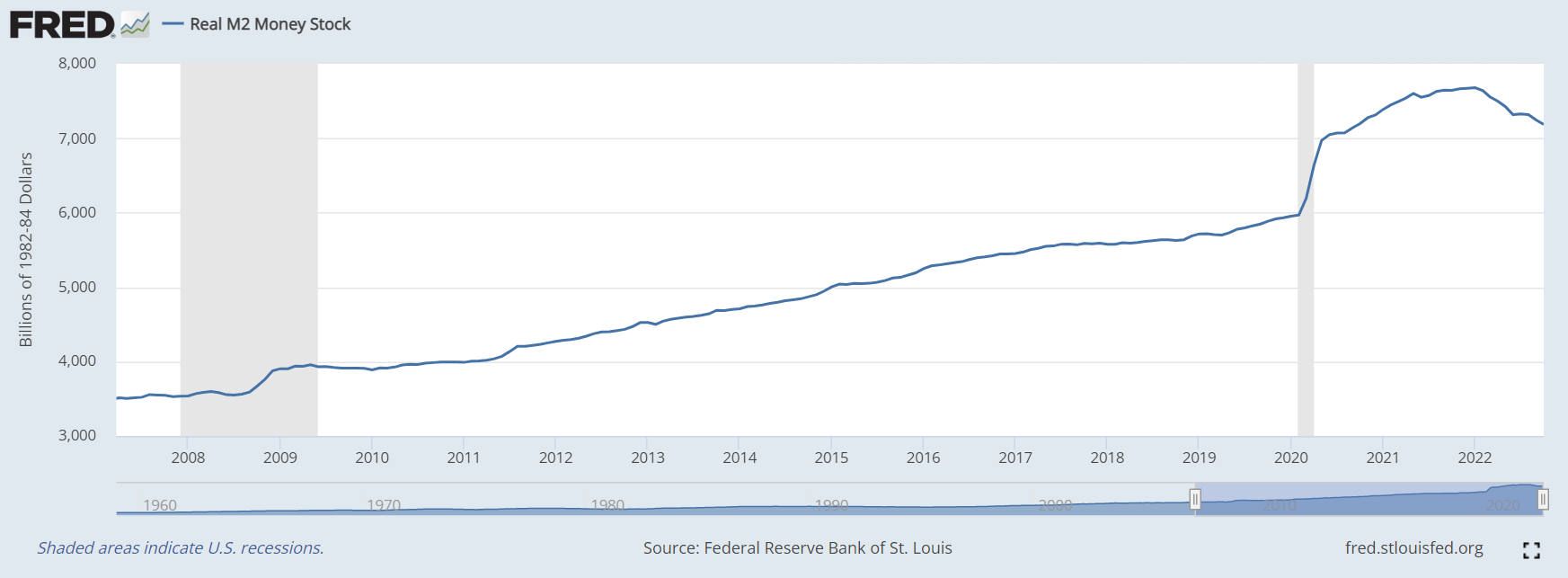
And as we can see in the chart below, the money supply moves almost exactly in tandem with fed asset purchases.
Although, this policy might sound like a good thing it is highly debated on whether it causes more harm than good.
Let’s look at the pros and cons of this policy…
Pros
Stimulates the economy
Asset prices rise due to increasing money supply
Cost of borrowing falls
Cons
Inflation rises due to increasing money supply
Increases government debt
Currency devalues
Quantitative easing can be seen as good or bad depending on what side of the coin you’re on.
Now let’s look at QE’s counterpart, quantitative tightening.
Quantitative Tightening
Quantitative tightening or QT is a monetary policy tool that the fed uses to take liquidity out of the market and slow down the economy.
This is the opposite of quantitative easing.
The fed uses this tool if inflation is running to high. When they reduce the amount of money in supply this makes dollars more valuable, and the price of goods and assets come down.
Raising interest rates and QT slow down the economy drastically. Borrowing costs are elevated, consumer spending goes down, and asset prices fall.
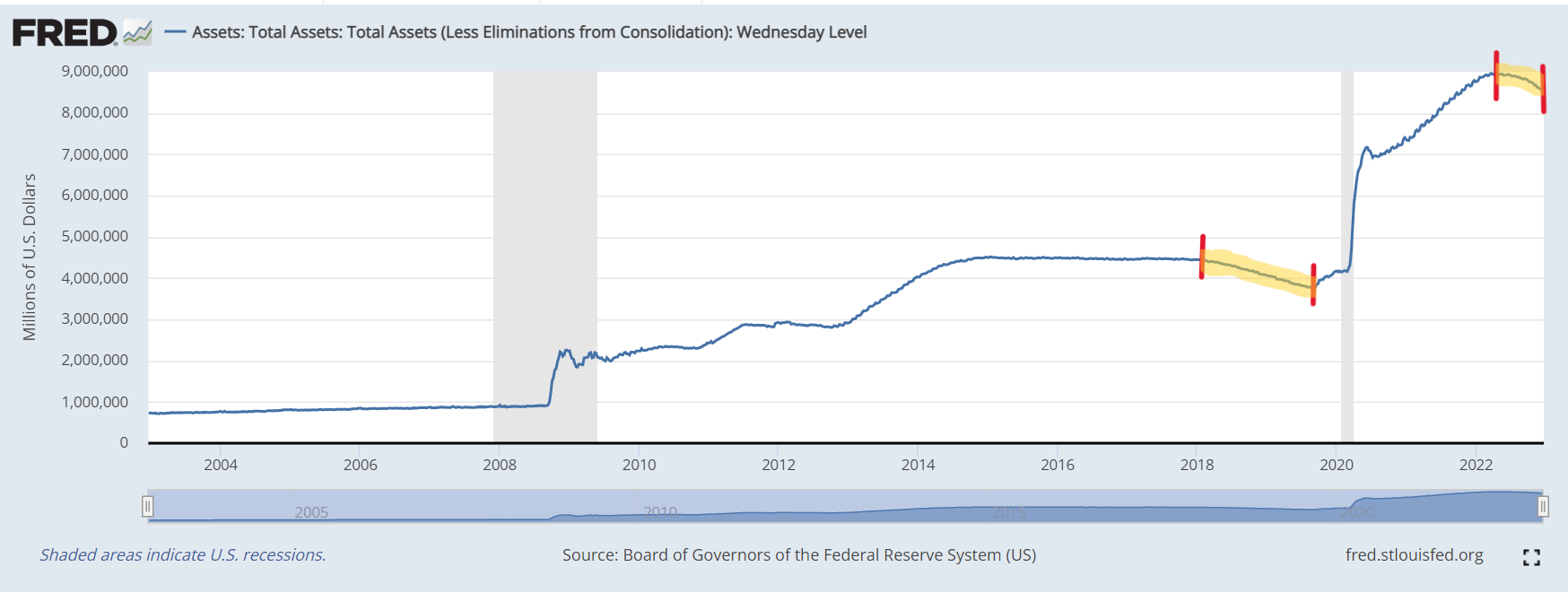
This is currently what we are seeing in 2022. The Fed announced that they were going to be tightening beginning on May 4th of this year to help combat inflation. QT was accompanied by increases in the federal funds rate to increase interest rates even further.
Here is what that looks like…
The yellow shaded areas mark when the Fed was decreasing the amount of assets on their balance sheet (QT).
QT can also be seen as good or bad depending on which side of the coin you’re on.
Pros
Brings inflation down
Strengthens dollar
Cons
Risk of recession increases
Asset prices fall
The Effects on the Market
During QE, if you have assets, you’re a winner because assets are rising in value, and if you have cash, you’re a loser because cash is losing value.
During QT, if you have assets, you’re a loser because assets are losing value, and if you have cash, you’re a winner because cash is rising in value.
Here is a look at the S&P 500 to see the periods of QT and QE, and how it affected the market.
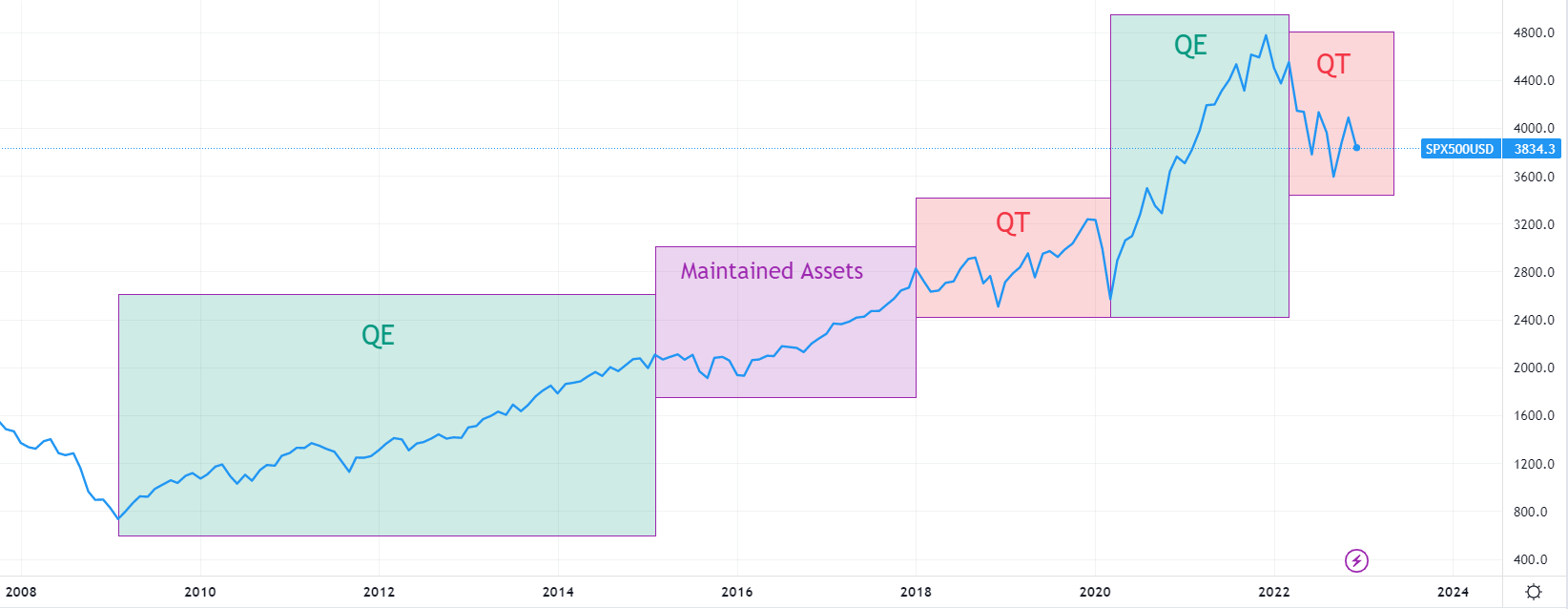
The periods of QE have significant increases in the stock market, and the periods of QT have significant decreases or consolidation.
The correlation between the Feds asset purchases, the money supply, and the stock market are very high.
Since the implementation of these policies in 2008, it seems the only way for assets to go up is for the Fed to be in a period of easing.
In 2022, we have seen an unprecedented pace of tightening, and the markets are getting hit hard. Since the Fed announced rate hikes and QT, the S&P has dropped 24% and is in bear market territory.
Investors are constantly looking for signals that the Fed will flip its monetary policy back to quantitative easing, but this is unlikely to happen soon.
The Fed is adamant about getting inflation down, therefore until we see inflation back at their goal of 2% it is unlikely that the fed will resume asset purchases (QE).
This year, we have seen the fastest pace of rate hikes ever, and this is increasing our risks of a recession. A lot of economists predict we will see a major recession in 2023, and a lot argue that we are already in a recession.
At some point the Fed will have to flip back to QE to stimulate the economy and get us out of a recession. This is why investors are anxiously awaiting this signal, because when it happens it will be off to the races again.
Conclusion
In conclusion, it is important to know about the current Fed policy when investing in the market. Knowing this will allow you to position yourself accordingly into cash or assets.
QE is good for assets, while QT is bad for assets.
QE is bad for cash, while QT is good for cash.
That’s it for this post. I hope you feel a little bit smarter after knowing the different policies the Fed can use to influence markets and the money supply.
Before leaving, feel free to respond to this newsletter with any questions or recommendations for future topics.